
Hunt
The Beagle as a loyal hunting companion
The Beagle is one of the oldest hunting dog breeds and has been bred in England for over 500 years specifically for hare hunting. The Beagle belongs to the Bracken and hound family.
Excerpt from the FCI standard
In the new Beagle standard, it is assumed that the Beagle was bred out of the larger Foxhound for hunting on foot, preferably for hares. However, this is not correct, especially as, according to old writings, the origin goes back to the Celtic Hound, the Northern Hound (later called Talbot). It is still used in the pack, very often organized by associations, academies and schools. A busy, eager little dog, full of enthusiasm and energy, always ready for any activity he can be a part of. Everything about this breed leaves the impression of athleticism and there is no better sight than a Beagle pack in full pursuit, their heads down on the scent, their tails stiffly arranged upwards as they concentrate on the hunt.
Character description
A cheerful dog whose main purpose is to hunt, mainly hares, by following the scent, fearless, extremely lively, with tenacity and determination, alert, intelligent and even-tempered. Amiable and alert, with no signs of aggressiveness or fearfulness.

The original task of the Bracken was to hunt game in a pack until it turned itself in or was brought back. The pack was sent out to search for the scent of a hare that had been brought back to the woods in the morning and as soon as a dog had picked up a scent, it indicated this by making a persistent scenting sound.
As the hare track is very fleeting and the scent cloud only remains in the track for a short time, the dogs had to have a very fine nose to keep the track.
New methods in the management and hunting of hoofed game have recently opened up new possibilities for the use of the beagle. Dogs with the finest nose, an enormous will to track and a loose tracking sound are required for rummage hunting. This is not a chase, as they follow the game with a deep nose.
Under today’s conditions, the Beagle is used as a small, versatile hunting dog. Its outward appearance, its small, compact shape and its social, calm and even-tempered nature make it ideal for hunters and their families.
Due to its breeding, the Beagle needs very close contact with its handler, who replaces his pack mates. Keeping the dog alone in a kennel is the worst thing you can do to him. This is one of the most important reasons for keeping him indoors. He is also very easy to groom due to his short hair, which is also supported by his body size and temperament.
Due to its size and general manageability, the Beagle is an ideal, problem-free companion. Due to its very good obedience, it can be taken along for stalking and hunting without hesitation if it has been prepared for this through training.
The Beagle’s strengths in hunting undoubtedly lie in rummaging and in hunting work.
It makes no difference whether the hunt is a small-scale rummage hunt with a few hunters or a large-scale driven hunt. The type of game also has no influence on the Beagle’s performance.
In general, the Beagle will work without problems with all game species in its area of use that it knows through training. Due to its small size and the typical brack work with a deep nose, it follows the game quite slowly. This is a considerable advantage over other, higher-running dog breeds, as the game is “announced” by the slow, loud dog with its sound and comes in front of the shooters in anticipation and can therefore be approached more safely and shot in a manner appropriate to the game. The hunter knows where the hunting dog is due to its reliable tracking sound.
His outstanding nose and the short distance to the ground as well as his enormous willingness to work predestine him for tracking and flushing work.
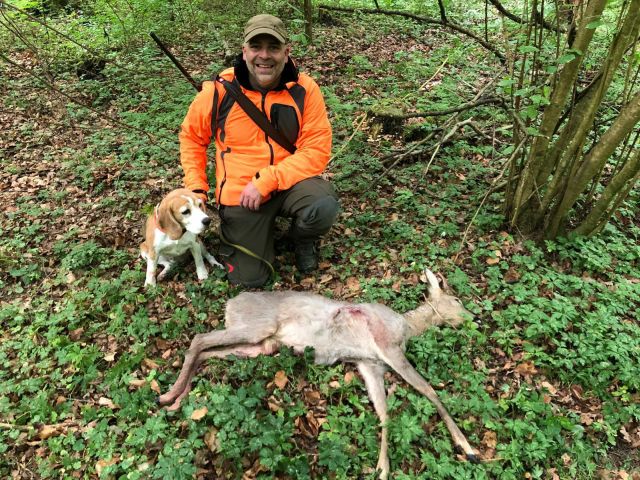
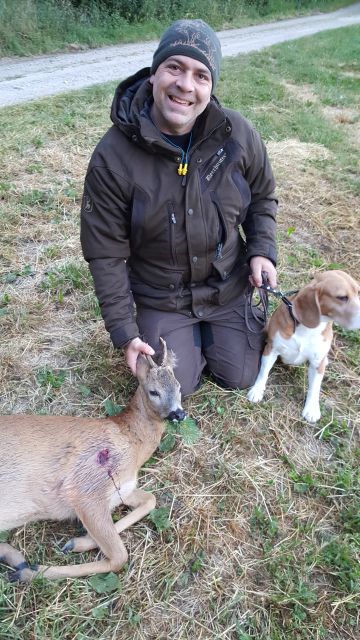
Hunting training
A well-trained beagle is a reliable hunting companion and a solid hunting dog training is mandatory. That is why we attend the ABC (Austrian Beagle Club) training days and tests with our dogs. We are very impressed by the philosophy and the approach and enjoy the camaraderie and the cozy get-together every time.
Hunting dog training in a hunting ground is essential and should begin playfully from puppyhood. It is not possible to train our hunting dogs solely on a dog training ground, as a hunting dog has to meet different requirements than a companion dog.
It must be carefully introduced to the many impressions in nature, to encounters with game and learn to use its outstanding nose, which is important for every hunting dog.
The Beagle is a loud-tracking hunting dog with a long history as a hunting dog. This heritage must be preserved! As part of the AUSTRIAN BEAGLE CLUB (ABC) tests, the hunting dispositions of the Beagle are tested and evaluated by the performance judges.
As breeders, we should incorporate this information about the dog’s performance into our breeding considerations for the future of the breed.
Sources: Austrian Beagle Club, Beagle Club Germany and FCI STANDARD